
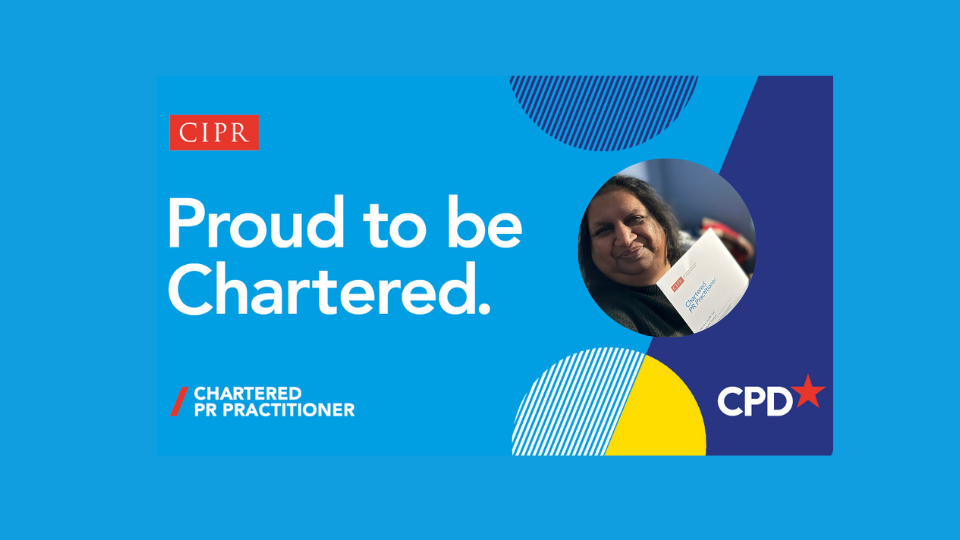
After 25 years at the strategy table, here’s why I finally went for Chartered status – and what it’s actually changed.
There’s a version of this post where I tell you Chartership taught me everything I know. That would be a good story. It would also be completely untrue.
I’ve been doing this for 25 years. I’ve written the strategies, managed the crises, and sat at boardroom tables where the stakes were real, and the room was not on my side. I didn’t go for my Chart.PR because I needed to learn how to be a strategist.
I went because, in 2026, experience is the baseline. Chartership is the differentiator.
“In 2026, being ‘experienced’ is expected. Being Chartered says you’re still setting the pace.”
Why Now? The Independent’s Calculation
When you leave an in-house role and go independent, you lose the shorthand of a corporate brand. You stop being “Head of Comms at [Company]” and become simply yourself. That’s both the freedom and the challenge of it.
I’d built a strong reputation. My clients trusted me. But I found myself thinking: trusted by whom, and verified by what?
Two things pushed me to finally hit submit:
– The external seal: My clients already hand me their reputations. Chartership provides the peer-reviewed confirmation that I’m operating at the ceiling of professional standards — the same way their accountant or lawyer has a body validating their expertise.
– The fractional argument: As a fractional lead, I’m often the most senior comms person in the room. I wanted the credential to match the responsibility.
A Genuinely Global Standard
I’ll be honest — I didn’t fully appreciate the reach of the CIPR until assessment day.
We were placed in small groups of four or five. Mine included practitioners from the US, the UK, and New Zealand. The woman joining from New Zealand did the entire session from 10 pm to 4 am her time! No complaints. Fully present. Sharp as anyone in the room.
That moment reframed what I was doing. This wasn’t a box-ticking exercise. It was a global community of senior practitioners who had all decided that standards matter — and were willing to prove it.
What “Chartered” Actually Means in Practice
Three things have shifted since I received my Chart.PR:
– Client conversations are different. I’ve always known the difference between outputs and outcomes. Now I have a framework — and a credential — that lets me make that argument stick at the board level. Fewer conversations about follower counts. More about business growth.
– The network is real. Being Chartered connects you to a high-calibre global community of practitioners. As a team of one, that matters more than I expected. The ‘brains trust’ is genuinely useful.
– Mandatory CPD keeps you honest. To maintain Chartership, you complete CPD every year. It’s not a burden — it’s a structure that ensures you stay ahead of what’s shaping the landscape in 2027 and beyond.
What I Didn’t Expect
The part that surprised me most wasn’t the assessment. It was the peer review of two-year CPD plans that followed.
Sitting with senior practitioners from different sectors and cultures, discussing where each of us wanted to be in two years, was unexpectedly grounding. It reminded me that the best people in this industry are still asking hard questions of themselves.
If you’ve been in PR for 10, 15, or 25 years and think you’ve earned the right to coast — I’d gently push back. Chartership isn’t about proving what you know. It’s about committing to staying exceptional.
“After 25 years, the credential wasn’t a starting line. It was a public commitment to the next 25.”
For Clients: What This Means for You
I now offer Chartered Strategic Audits for brands looking to align their communications with their 2026 business objectives.
If your communications strategy is working hard but you’re not sure it’s working smart, let’s talk. A Chartered Strategic Audit is a focused diagnostic: where your comms stands today, where the gaps are, and what a sharper strategy looks like going forward.
Contact me to arrange a call

Leave a Reply