
If you work in communications in the charity sector, you already know: “do more with less” is not a temporary crunch. It’s the permanent state of play. Comms teams are being cut to one person. You’re expected to cover internal, external, and public affairs, as well as fundraising, simultaneously. And somewhere in the middle of all that, burnout arrives quietly, without announcement.
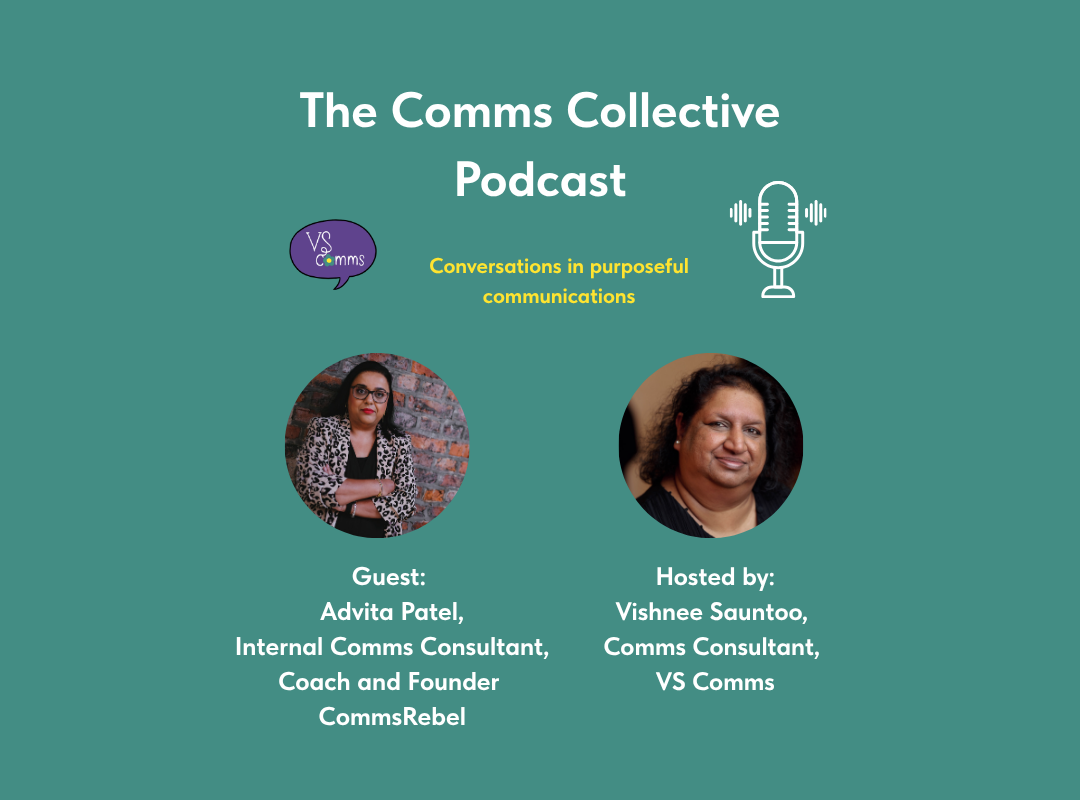
In the latest episode of The Comms Collective, I sat down with Advita Patel – internal comms specialist, coach, founder of CommsRebel, and author of her new book Decoding Confidence: The Seven Habits of Confident Leaders. Advita has spent nearly two decades in internal communications, working extensively with charities and not-for-profit organisations. She knows this world from the inside out.
The Path to CommsRebel
Advita’s career didn’t start in comms. She went to university to study IT, aiming to be “the Asian version of Bill Gates.” After graduating into the dot-com crash, she ended up in an admin role at a university, where she built a Microsoft Access database to digitise UCAS forms, caught the attention of a marketing manager named Catherine, and was taken under her wing.
Catherine spotted what Advita couldn’t see in herself: a natural talent for marketing. After changing her master’s to strategic marketing and spending a day a week shadowing Catherine, she applied for her first comms role — which turned out to be internal communications. She’s been in the field ever since.
Her coding background — HTML, C++, JavaScript — became an unexpected differentiator. At a time when almost no comms professionals could build intranets from scratch, Advita could. She bridged the gap between IT and internal comms in a genuinely rare way.
By 2018, though, she felt stuck. She was told that reaching director level meant relocating to London, and she had no intention of leaving Manchester. A confidence crash followed. A good friend delivered a blunt but necessary reality check: “You’re in control of your destiny. Get a grip.” In January 2020, Advita launched CommsRebel. Nine weeks later, the world shut down. She kept going anyway.
Why This Episode Matters for Charity Comms Professionals
Advita’s clients include Action for Children, the Refugee Council, and several other not-for-profit organisations. She understands resource constraints from the inside and offers tailored advice for charity professionals, emphasising that her insights are directly applicable to your sector’s unique challenges.
But she also sees what sustained pressure does to people over time. Comms teams are being stripped back. Individuals are covering functions that would be entire departments elsewhere. And because people in the charity world are so passionate about the cause, saying no feels like a betrayal. That passion, Advita argues, is a double-edged sword. When it stops you from setting realistic limits, it accelerates the very burnout that makes you less effective for the people you’re trying to serve.
What Confidence Actually Means
Advita’s book – her second, following a co-authored work on inclusive cultures – is built around the BELIEVE framework: seven habits of confident leaders. Each letter stands for Boldness, Empathy, Learning, Integrity, Empowerment, Vulnerability, and Energy.
The starting point is a reframe. Confidence isn’t about being the loudest person in the room or projecting certainty. The word itself comes from the Latin con fidere, “with trust.” It’s about trusting yourself enough to know that whatever happens, you can handle it. And it’s accessible to everyone, not just the naturally extroverted.
For comms professionals, Advita identifies a specific confidence erosion cycle: you get buried in tactical requests, start second-guessing yourself, pull back, keep your head down — and suddenly you’ve handed over any strategic influence you had. Breaking that cycle requires self-knowledge: knowing your values, your communication style, your strengths and gaps so well that other people’s opinions can’t knock you off course.
Key Lessons from the Episode
Confidence is self-trust, not certainty
Stop waiting for external validation before you act. The clearer you are about who you are and what you stand for, the harder it is for anyone to destabilise you.
Energy is your foundation
Of all seven BELIEVE habits, Advita calls energy the most important, because without it, you cannot practice any of the others. Burnout doesn’t announce itself. You feel it when you’re already in it. Advita’s conviction here comes from experience: early in her career, she worked on an NHS mental health ward and met many people who hadn’t spotted the warning signs early enough. She’s never forgotten it.
“If you burn out and go off sick,” she says, “you’ll get flowers and a card. And you’ll be replaced tomorrow.”
There’s neuroscience behind this too. Your amygdala, the part of the brain that triggers stress, hasn’t evolved since our ancestors lived in caves. A ping from an email activates the same fight-or-flight response as a predator approaching. We are absorbing that stress dozens of times a day, and most of us have stopped noticing.
Be the editor, not the messenger
You are a subject matter expert hired for your judgement, not just your ability to execute. Your job is to give leadership the options and the consequences of each communication path, not to make decisions for them, but to ensure they make informed ones. When you get buried in tactics, you lose sight of that strategic value. So does everyone else.
Build your Learning Circle
Your personal board of directors, no more than 15 people, should include three types: Believers (who champion you), Bridges (who open doors and make connections), and Challengers (who hold a mirror up and tell you when you’ve been drinking your own Kool-Aid). Everything outside that circle is noise. Be deliberate about whose feedback you actually act on.
Start a Happiness Folder
Create a simple folder on your phone or desktop and save positive feedback, LinkedIn messages, and encouraging comments. When imposter syndrome hits, and it will, go back to that folder. Advita calls this “reminding yourself of your greatness and your genius.” It’s a small habit with an outsized effect.
Practical Tools for Reclaiming Your Workload
Advita recommends starting with a week-long time log, writing down everything you do, hour by hour. Where is your time actually going? She did this herself and discovered she was spending an hour a day on Instagram Reels in decision-fatigue moments she hadn’t even noticed.
- The Time Log: Spend one week logging every hour of your working day. What are you actually doing? Who is commanding your time? Where is your energy going?
- The Eisenhower Matrix: Sort everything into four categories — Do, Delegate, Remove, or Park. Seeing your workload mapped this way creates clarity quickly. Here is a worksheet to help!
- The Pomodoro Technique: Work in focused bursts (Advita’s natural attention span is around 24 minutes) with your phone on aeroplane mode and your inbox closed. Short break, then back. Repeat.
- Email hygiene: Stop using your inbox as a to-do list. Check email three times a day — morning, midday, and before you log off. Nothing urgent enough to matter will fall through the gap.
🎁 Book Giveaway
Advita’s book Decoding Confidence is out now. I pre-ordered a copy last year and forgot, so I have a spare, and I’m giving it away. Advita has also offered to sign and personalise it when we next meet in London.
To enter, send me a DM on LinkedIn or Instagram with the word CONFIDENCE.
You can also buy a copy at Waterstones, Amazon, Blackwell’s, or WH Smith — or get a personalised copy directly from Advita at decodingconfidence.com.
Click below to listen to the full episode with Advita Patel on your favourite platform.
Listen on Spotify |Listen on Apple Podcasts | Listen on Amazon Music
Leave a Reply